Remembering Pearl Harbor
By Dave Cano
Various history publications and news outlets have rated the most consequential events and stories of the last century. Two that come to mind on most lists are the terrorist attacks in New York City on September 11, 2001 and the attack on Pearl Harbor on Dec 7, 1941. The attack on American Naval forces at Pearl Harbor in Hawaii in 1941 is what marked the United States entry into World War II. On this 84-year anniversary of that infamous day, Americans remember the bravery of those who were present on the island of Oahu during that attack, as well as continue our quest to learn from history and prepare ourselves for future threats. Most historians agree that the attack on Pearl Harbor amounted to an intelligence failure very similar to September 11. It can be very difficult for even the most talented and qualified officials to decipher exactly which patterns and signals will carry on a deadly attack. Before 9/11, there was the October 12, 2000, USS Cole bombing along with other intelligence signals indicating a possible attack on U.S. soil from jihadist groups. 60 years prior, the Japanese had also been showing signs of pending hostility towards the United States military for certain reasons. Japan had been at war with China, and the Japanese empire had been expressing its intention of expanding throughout Southeast Asia. There was also the issue of oil where Japan has been dependent on the United States which led to an embargo after Japan’s aggression and war on China. The Japanese also felt that the United States was particularly vulnerable to an attack and quick defeat if they could destroy the American Pacific fleet during a surprise attack. Therefore, Japan carried on its brazen attack that Sunday morning on December 7, but also discovered something within the immediate hours of the attack. They discovered something unexpected that is not discussed in many historical and official accounts. This revelation is what caused Japanese admiral Yamamoto to proclaim, “I fear we have only awakened a sleeping Giant and filled him with terrible resolve”. I will talk more about that in a bit.
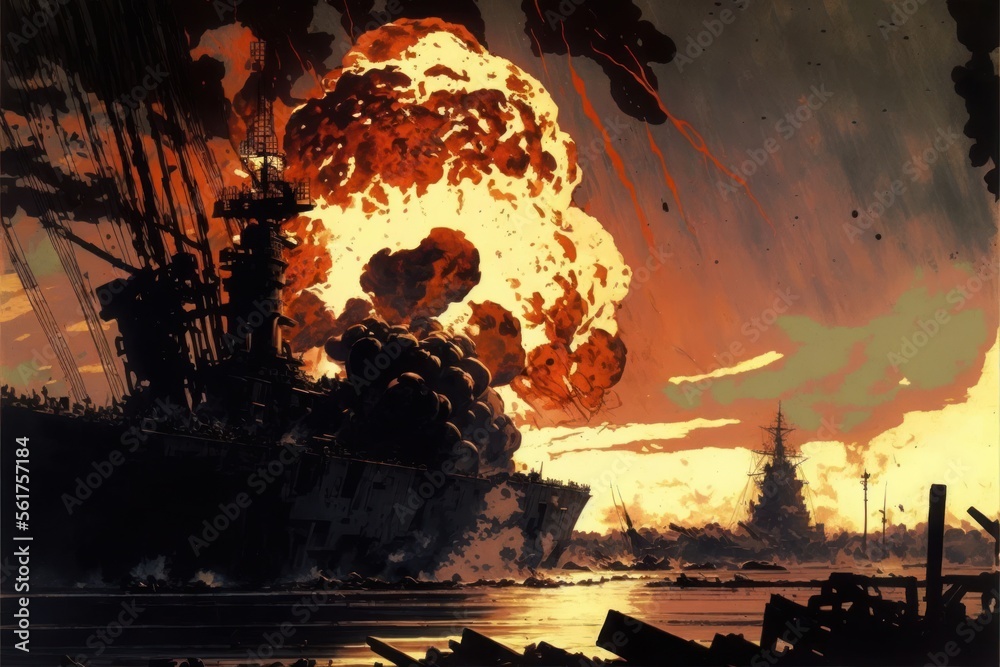
The preparation for the December 7 attack on American naval forces at Pearl Harbor began months before the attack. The attack was eventually carried on early that Sunday morning with 6 Japanese aircraft carriers and 350 aircraft. The various Japanese aircraft that conducted the strikes were armed with various bombs, aerial torpedoes, and machine guns. As the planes swept in that morning for their various attack waves, the battleships were the main target of initial strikes. As the secondary wave of attacks were conducted, other naval vessels and aircraft were damaged and destroyed. At the end of the brutal attacks, over 2.400 American Servicemembers were killed and over 1,178 were wounded. The USS Arizona was completely sunk as most of the American servicemembers who were killed were on board. Many of the ships that were attacked and damaged were eventually repaired and serviceable. Fortunately, portions of the repair depots and fuel facilities were spared. A very significant feature of that day is that the 3 American Aircraft carriers, the USS Lexington, the USS Saratoga, and the USS Enterprise were at sea conducting operations. Despite the surprise element of the attack, several Sailors were able to man guns and weapons to counterattack some of the Japanese planes showing exemplary bravery.
President Frankin D. Roosevelt received notification hours after the attack. Since he had been the Assistant Secretary of the Navy two decades prior, the news was particularly devastating and personal for him. On December 8, 1941, before a Joint session of Congress he made a declaration of war against Japan supported by an 82-0 approval vote in the Senate and a 388-1 approval vote in the House of Representatives. His words were powerful, emotional and direct as he stated, “the day that will live in infamy”. For those of us who remember September 11, 2011, one could only imagine the sense of shock and anger that reverberated throughout the nation. Isolationist groups immediately dissipated as the United States Military and Industrial complex went into full gear making tanks, aircraft, ships, and weapons. Recruitment centers had lines not seen in decades and patriotism was at all-time high. The sense of American honor and survival was at stake in light of such an aggressive attack along with the consideration of the war in Europe against Hitler and the Axis powers there. The United States eventually engaged a two-front war as the Army with leaders like General Dwight Eisenhower and General George Patton engaged the European front. The United States Navy and Marine Corps engaged the Pacific side against Japan, led by Admiral Chester Nimitz and Marine Corps General Chesty Puller. After 4 years of warfare, World War II ended when both Germany and Japan surrendered in 1945. The Japanese surrender occurred on the deck plates of the same type of ship they sunk 4 years prior, an American battleship, the USS Missouri.
The Japanese Admiral Yamamoto stated famous words within 24 hours after the attack on Pearl Harbor. He said,’ I fear all we have done is awaken a sleeping giant and filled him with terrible resolve”. I was stationed in Japan for 5 years during my Naval Career; two years in Okinawa and 3 years abord the USS George Washington out of Yokosuka Japan. Though I was deployed half of time of my tour aboard the Aircraft carrier, I was able to gain a keen sense of the Japanese mindset, respectively, as a curious person. I developed and still maintain a great respect for the Japanese people and understand their history as well as their disposition towards honor. Therefore, someone of the Harvard educated Yamamoto’s caliber and discernment had to know the gravitas of the enemy he had just made. Just like an athlete or pugilist who may suddenly recognize or be shocked at the strength of their opponent once they are engaged in actual combat, in like manner the damage assessment reports that Yamamoto received did not tell the full story. There are times and moments in reality and history when the full strength and resolve of a people does not become evident until after they have been attacked. Yamamoto sensed the truth. He felt that he was now up against an enemy that like their Samurai warrior of centuries past, had its own warriors. A true warrior identifies their kind. He was against a nation that had produced warriors like George Washington, John Paul Jones, and Ulysses S Grant, and was now on the cusp of a new generation of legends like Eisenhower, Nimitz, and Patton who were leading a new generation of American warfighters. Pearl Harbor was a day of infamy, where America’s World War II experience began, but it didn’t end there. I would never bet against the United States of America. If you hit America, we have shown time and time again that we will take the hardest hit and come back ten times stronger. I believe the Admiral knew, deep in his soul, he hit a nation and people that were not going to stay lying down.